
Table of Contents
When relationships feel strained or emotions become overwhelming, many people wonder if there’s a way to feel connected again. Emotional Therapy, particularly Emotionally Focused Therapy (EFT), offers a proven path to healing and stronger bonds while supporting overall Mental Health and emotional resilience.
At AM Counselling, I’ve seen firsthand how understanding what is Emotional Therapy can transform lives and relationships.
Understanding What is Emotional Therapy
Emotional Therapy is a structured, evidence-based approach that focuses on helping people understand and work with their emotions rather than trying to eliminate them. At its core, emotion-focused therapy is about recognizing that emotions aren’t problems to fix—they’re valuable signals that guide us toward healing and connection.
Developed in the 1980s by psychologists Dr. Sue Johnson and Dr. Les Greenberg, this therapeutic approach is grounded in attachment theory. It recognizes that humans have a natural need for secure emotional bonds throughout their lives. When these bonds are threatened or broken, we experience distress that shows up in various ways—relationship conflict, anxiety, depression, or feeling disconnected from ourselves and others.
Why Emotional Therapy Works
What makes Emotional Therapy particularly valuable is its evidence-based foundation. Decades of research support its effectiveness, and it’s currently recognized as a gold standard for couples therapy. Research shows impressive results—70-75% of couples move from distress to recovery, and up to 90% report significant improvements. It also shows strong results for individual depression, anxiety, and trauma symptoms.
Unlike approaches that focus solely on changing thoughts or behaviors, Emotional Therapy recognizes that lasting change happens when we address the emotional experiences driving our patterns. For people who struggle to express emotions or who see emotional expression as weakness, EFT provides a safe framework.
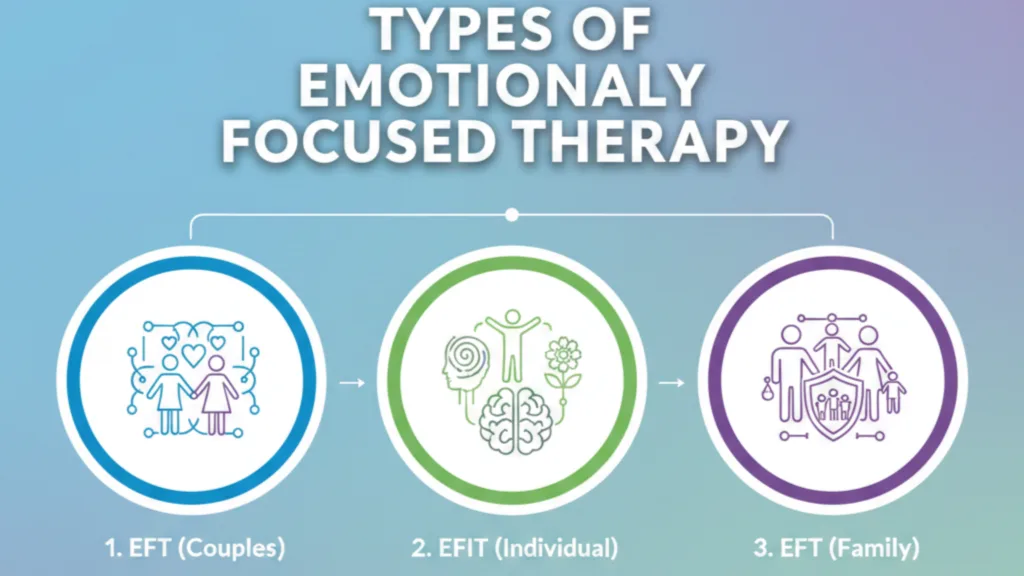
Types of Emotionally Focused Therapy: Which One is Right for You?
Understanding what is EFT becomes clearer when you see how it adapts to different situations. Here’s a simple breakdown of the three main approaches:
| Therapy Type | Who It’s For | Primary Focus | Main Goals |
| EFT (Couples) | Romantic partners | Rebuilding emotional connection between partners | Strengthen attachment bonds, improve communication, resolve conflict patterns, restore intimacy |
| EFIT (Individual) | Individuals dealing with personal challenges | Developing a secure relationship with oneself | Manage anxiety/depression/trauma, improve emotional regulation, build self-compassion, prepare for healthy relationships |
| EFFT (Family) | Parents, children, and family units | Repairing family bonds and improving family dynamics | Create secure family patterns, enhance parent-child communication, heal relationship wounds, strengthen caregiving responses |
All three approaches share the same foundation—attachment science and the power of emotions—but each is tailored to specific relationship contexts. Whether you’re seeking individual Mental Health support, couples therapy, or family healing, emotionally focused approaches can be delivered effectively by trained professionals, including Registered Social Workers—an important distinction for those comparing social worker vs therapist services.
How Emotional Therapy Works: The Three Stages
Whether working with individuals, couples, or families, Emotionally Focused Therapy follows a clear structure designed to create lasting change. Working with a Registered Social Worker or trained therapist, you’ll move through three distinct stages.
Stage 1: Identifying the Problem Patterns
First, therapists help identify the negative patterns causing distress. This might be a cycle where one partner withdraws while the other pursues, or where family members blame each other instead of addressing underlying fears and needs. Simply recognizing these patterns can bring relief because couples and families realize the pattern itself—not the people—is the problem.
Stage 2: Transforming Emotional Responses
Next comes the transformational stage, where deeper emotions surface. People learn to share their vulnerabilities and attachment needs in a safe environment. Instead of expressing anger or criticism, they discover the hurt, fear, or longing underneath. This emotional honesty creates opportunities for genuine connection and understanding.
Stage 3: Building New Patterns
Finally, new healthy patterns are consolidated. Couples and families practice responding to each other with understanding and care. They learn to recognize emotional signals and respond in ways that strengthen rather than damage their bonds. These new patterns become the foundation for lasting change.

What is EFT Couples Therapy?
For couples seeking couples counselling Alberta services, understanding how EFT works can be reassuring. When people ask what is emotion focused therapy in the context of relationships, they’re referring to how it helps partners reconnect emotionally.
The therapy doesn’t blame either partner for relationship problems. Instead, it views distress as arising from disconnection and unmet attachment needs. During sessions, therapists help couples understand their emotional responses to each other. Maybe one partner criticizes because they feel ignored and helpless. The other withdraws because they feel overwhelmed and afraid of further conflict. By uncovering these softer emotions beneath the reactive behaviors, couples can respond to each other with compassion rather than defensiveness.
EFT couples therapy is particularly effective for relationships experiencing intense conflict, trust issues after infidelity, communication breakdowns, or emotional distance. Those considering marriage relationship counseling should know that Emotional Therapy offers more than conflict resolution—it helps partners understand the emotional dynamics underneath surface arguments, creating lasting change rather than temporary fixes.
Benefits Beyond Couples: Individual and Family Applications
While EFT is best known for helping couples, its principles apply powerfully to individual therapy and family work. For individuals dealing with anxiety, depression, or trauma, Emotional Therapy provides tools to understand and regulate emotions. Instead of feeling overwhelmed by feelings, people learn to use emotions as helpful information guiding their choices.
Families benefit from EFFT when communication has broken down or when members struggle to support each other during difficult transitions. Whether dealing with parenting challenges, teen rebellion, or life changes, families learn to express needs and respond to each other with empathy. The same attachment principles that heal couple relationships also strengthen family bonds and parent-child connections.
The therapy is time-limited, typically involving 10-20 sessions, making it both effective and efficient. This means you can see meaningful progress without years of ongoing therapy.
Taking Your First Step Toward Healing
Understanding what is Emotional Therapy is the first step toward transforming your relationships and emotional well-being. Whether you’re experiencing relationship distress, individual challenges, or family communication issues, EFT, EFIT, and EFFT offer structured, proven paths to healing.
I, Ayen Mabor, a Registered Social Worker and a trained professional at AM Counselling Services Calgary, understand how to apply these principles to help you create secure, meaningful connections. The journey begins with recognizing that emotions matter, that connection is essential, and that with the right support, change is possible.
Ready to strengthen your emotional bonds?
Schedule an appointment with me right now and begin your journey toward lasting connection and emotional health.